
Over six years, water and wastewater costs rose sharply; meanwhile, electricity costs stabilized or slightly decreased in some areas. Previously, large facilities relied on chilled water and cooling tower systems as the standard for air conditioning.
However, concerns about Legionella, water scarcity, and high-performance goals are prompting reevaluation of water use in cooling systems. As a result, the HVAC industry is evolving to improve both energy and water efficiency in system design.
Therefore, facility managers must understand these trends and the energy-water connection to reduce costs and enhance sustainability. Twenty years ago, facilities chose between air-cooled and water-cooled systems, with cooling towers preferred for large buildings.
Back then, chilled water systems offered better energy efficiency than direct expansion systems, making them the top choice. But now, these systems consume large water volumes, often accounting for one-third to half of a building’s total water use.
Consequently, rising water costs and scarcity are driving interest in alternative cooling strategies for commercial buildings.
Looking ahead, three key factors will shape the future HVAC design and system choices.
- Water costs
- New technologies
- Efficiency goals
Energy / Water Nexus
Regarding energy efficiency, new chillers and water-cooled VRF systems introduced a new era of high-performance cooling technologies. However, when fan, pump, and compressor energy are combined, system efficiency ranges between 0.55 and 0.75 kWh/ton hour. Meanwhile, air-cooled direct expansion systems operate around 0.95 kWh/ton hour, showing lower efficiency compared to water-cooled alternatives.
Additionally, air-cooled VRF systems typically run at approximately 0.85 kWh/ton hour, based on IEER approximations. Therefore, water-cooled systems offer energy savings of 0.15 to 0.4 kWh/ton hour compared to air-cooled systems. In today’s electricity market, these savings translate to 1 to 4.5 cents per ton hour, depending on location and system.
Previously, water and sewer costs from cooling towers received little attention; however, that trend is rapidly changing nationwide. Meanwhile, electricity prices are stabilizing or declining, but water and wastewater costs continue rising about 6% annually. In fact, Circle of Blue reports water and wastewater rates rose 41% in 30 major cities from 2010–2015.
Currently, average commercial water and sewer rates nationwide are $10–$11 per thousand gallons, or 1–1.1 cents per gallon. Moreover, aging infrastructure, limited water supply development, and stricter regulations suggest rising water costs will persist long-term.
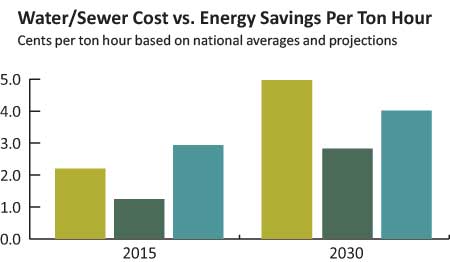
To illustrate, cooling towers at four cycles need about 2 gallons of makeup water per ton hour of air conditioning. Consequently, this equals 1.9 to 2.2 cents per ton hour in water and wastewater costs. Even with evaporative credits, combined water and sewer costs range from 1.25 to 1.75 cents per ton hour. If inflation continues at 6% annually, future water and wastewater costs may reach 3 to 5 cents per ton hour. Meanwhile, over 15 years, commercial electric rates remained stable or declined slightly due to cheaper natural gas.
According to DOE projections, electricity costs may rise from 9–10 cents to 12–14 cents per kWh over 15 years. Additionally, cooling tower treatment, labor, Legionella prevention, and liability can add 0.1 to 0.5 cents per ton hour. Therefore, rising water costs may offset energy savings traditionally gained from cooling tower systems.
The chart below compares water/sewer costs and energy savings per ton hour using national data and projected inflation rates. If trends continue, by 2030, water and wastewater may cost more than energy saved by cooling towers.
In conclusion, cooling towers remain vital, but it’s time to explore alternative HVAC options for future sustainability.